

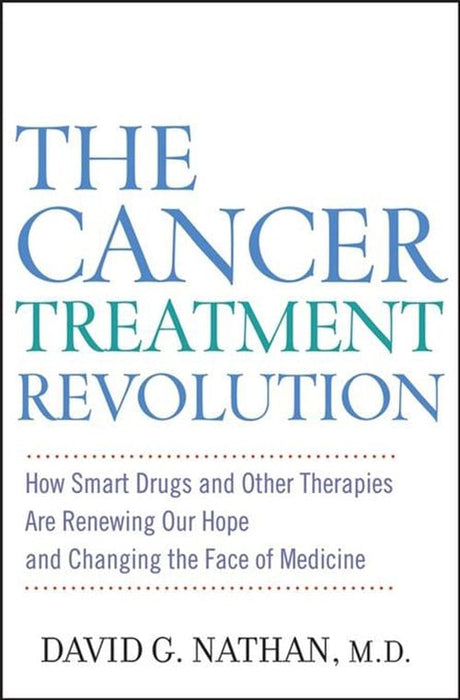
The Cancer Treatment Revolution: How Smart Drugs and Other New Therapies are Renewing Our Hope and Changing the Face of Medicine
"A wonderful journey through modern medical science, told with warmth and insight, brought to life through the stories of people confronting cancer. This book will inspire and educate both laymen and caregivers."
—Jerome Groopman, M.D., author of The Measure of Our Days and The Anatomy of Hope and Recanati, Professor, Harvard Medical School
"This is probably the best book on cancer that exists--beautifully written and unfailingly interesting, conveying a clear sense of hope for cancer patients and survivors. Cancer treatment has come a long way but not without intense struggles and passions, which David Nathan narrates from the inside as one of the leading players. He explains cancer more clearly than anyone else, and his portraits of great cancer doctors are sharp and unforgettable, a contribution to history."
—Richard Preston, author of The Hot Zone and The Demon in the Freezer
"No one is better positioned to tell the tale of the cancer treatment revolution of the last half century than David Nathan. A brilliant physician-scientist, he has been present at the cusps of history in this life-and-death field. The story he tells here is fascinating, and his book is captivating."
—Atul Gawande, M.D., author of Complications: A Surgeon's Notes on an Imperfect Science and Better: A Surgeon's Notes on Performance and Assistant Professor of Surgery, Harvard Medical School
"David Nathan is a true storyteller. In The Cancer Treatment Revolution, he tells stories that bridge cancer patients and cancer research as few others could. These gripping tales will be appreciated by those who live with cancer and those who strive to create new therapies."
—Thomas Cech, Ph.D., recipient of the 1989 Nobel Prize in Chemistry and President of the Howard Hughes Medical Institute
"David Nathan, one of the nation's preeminent clinician-scientists, tells the stories of three cancer patients, revealing compelling human facets--the dedication of the remarkable teams that care for these patients and, even more, the bravery and fortitude of the patients and their families."
—Harold Varmus, M.D., recipient of the 1989 Nobel Prize in Medicine, President of the Memorial Sloan-Kettering Cancer Center, and former director of the National Institutes of Health
"Engaged by the compelling triumphs and tragedies of patients whose normal lives are inevitably altered by a life-threatening cancer, the reader of The Cancer Treatment Revolution will easily appreciate the impact of the new cancer diagnostics and therapies compared to even relatively recent cancer treatments."
—Karen Antman, M.D., Dean, Boston University School of Medicine
"This personal, highly readable account by one of the leaders of the cancer treatment revolution explains how the revolution has come about and how it will change the future."
—Sir Paul Nurse, Ph.D., President of Rockefeller University and recipient of the 2001 Nobel Prize in Medicine
We earn a commission for purchases made through the following links.
Book details
- Author
- David G. Nathan, M.D.
- Imprint
- Trade Paper Press, an imprint of Turner Publishing Company
- Published
- Pages
- 272
- Formats
- Hardcover
- Subjects
- Health & Fitness › Diseases & Conditions › Cancer
- Topics
- oncology · cancer research · targeted therapies · patient stories · medical breakthroughs · cancer medicine
- ISBN-13
- 9780471946540
About the author
DAVID G. NATHAN, M.D., is an American pediatrician and hematologist and the editor of Nathan and Oski’s Hematology of Infancy and Childhood, the leading textbook of pediatric hematology. He is also the author of Genes, Blood, and Courage.
Nathan is the recipient of the National Medal of Science, the John Howland Medal of the American Pediatric Society, and the George Kober Medal of the Association of American Physicians. He holds the Robert A. Stranahan Distinguished Professorship of Pediatrics and a professorship of Medicine at Harvard Medical School, and is a member of the Institute of Medicine of the National Academies of Science, the American Academy of Arts and Sciences, and the American Philosophical Society.