

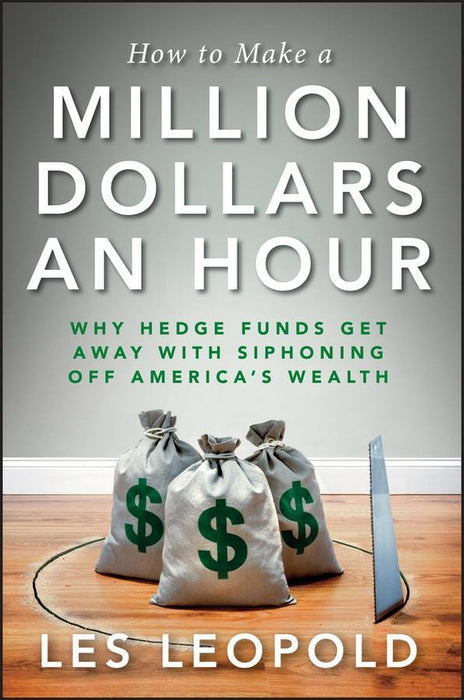
How to Make a Million Dollars an Hour: Why Hedge Funds Get Away with Siphoning Off America's Wealth
- Takes a fascinating tour of the wild side of fantasy finance to explain just how hedge fund managers make so much money--and whether or not the million-an-hour crowd produces anything positive for society and the economy
- Teaches you hedge fund secrets that make it possible to pull down astounding sums in the space of minutes--from rigging your bets to milking millions in special tax breaks--if you're willing to bankrupt your morality for the cash
- Counters many of the most common arguments about why speculating in financial markets is somehow "worth more" than creating entertainment, electronics, or consumer goods that consumers want
- Written by Les Leopold, the popular AlterNet writer and author of The Looting of America
We earn a commission for purchases made through the following links.
Book details
- Author
- Les Leoppold
- Imprint
- Trade Paper Press, an imprint of Turner Publishing Company
- Published
- Pages
- 272
- Formats
- Hardcover
- Subjects
- Political Science › Political Economy
- Topics
- income inequality · wealth inequality · political economy · Wall Street · financial industry · economic criticism
- ISBN-13
- 9781118239247
About the author
LES LEOPOLD is a labor educator, co-founder of the Labor Institute, and the author of several books, including Wall Street’s War on Workers, Runaway Inequality and How to Make a Million Dollars an Hour.
His biography of labor leader Tony Mazzocchi, The Man Who Hated Work and Loved Labor, won the Gold Medal from the Independent Publisher Book Awards for best biography in 2008. Leopold holds degrees from Oberlin College and Princeton University’s Woodrow Wilson School of Public and International Affairs.
When he’s not writing, Leopold directs the Public Health Institute and leads the Labor Institute, a nonprofit he founded in 1976 that designs research and educational programs on occupational safety and health, the environment, and economics for unions, worker centers, and community organizations.