
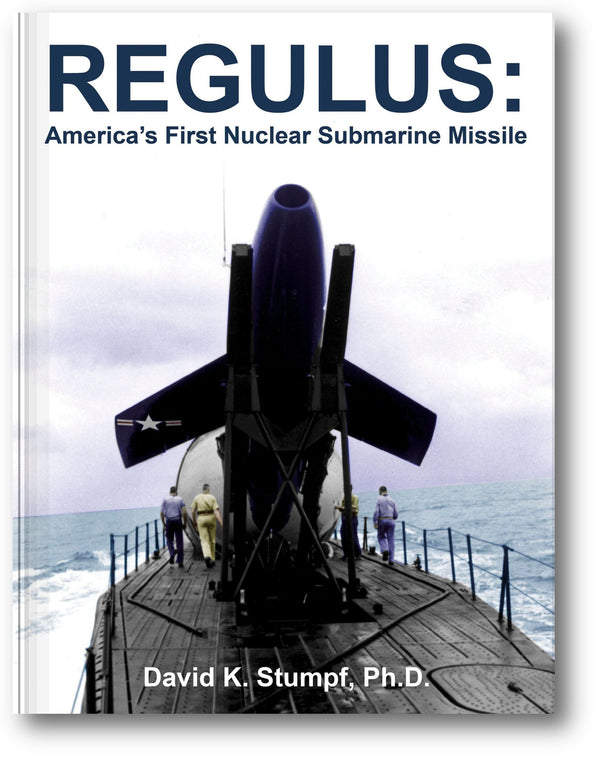
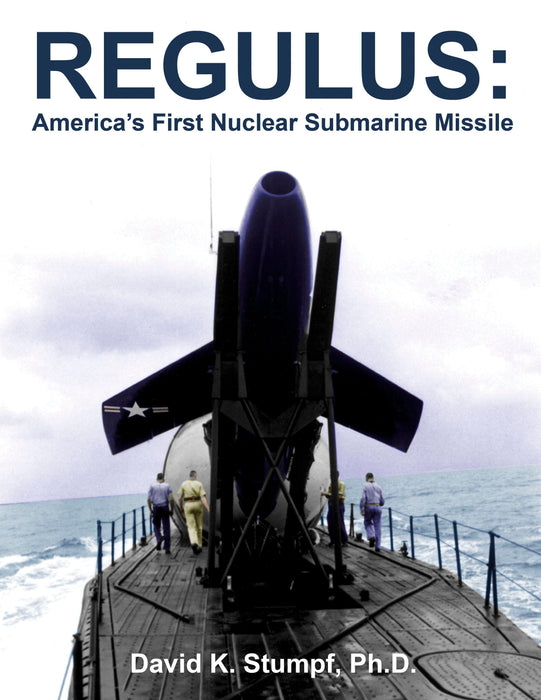
Regulus: America's First Nuclear Submarine Missile
In the closing months of World War II, guided missile technology blossomed as a technological breakthrough for the delivery of offensive weapons. Late in the war, Germany introduced its V-1 and V-2 missile systems, and the Soviet ballistic missile program late in the decade heightened the need for a U.S. intermediate-range missile program.
During this period, the Chance Vought Aircraft Corporation, famous for its F4U Corsair aircraft among others, began work on a new guided missile program with the U.S. Navy—giving birth to the Regulus missile.
Regulus: America's First Nuclear Submarine Missile provides a detailed report on Chance Vought's Regulus I and II guided missiles, the program that paved the way in the fields of inertial navigation, missile guidance and impact accuracy. The book covers examples of the day-to-day operations as well as the yearly milestones for the program as it reached operational status, and covers naval deployment on aircraft carriers, to heavy cruisers and finally to the five submarines that patrolled the North Pacific. Detailed appendices include detailed discussions of the missile's guidance systems, nuclear warheads, flight operations and production summaries.
Regulus was an important step in the evolution of America's missile defense program, and this book is a fitting tribute to the history of this complex system, and the people who made it happen.
We earn a commission for purchases made through the following links.
Book details
- Author
- David Stumpf
- Imprint
- Turner Publishing Company
- Published
- Formats
- Hardcover
- Subjects
- Technology & Engineering › Military Science
- Topics
- nuclear submarines · guided missiles · Cold War weapons · U.S. Navy history · Regulus missile program · submarine warfare · military technology
- ISBN-13
- 9781596521834
About the author
DAVID K. STUMPF is a retired plant biochemist and military historian who has written six books on American weapons systems. His recent books include The Last Thirty Seconds, Growler and Grayback: Two of a Kind and Minuteman: A Technical History of the Missile That Defined American Nuclear Warfare.
Stumpf holds a Ph.D. in Plant Biochemistry from the University of Madison and worked as a research scientist at the University of Arizona. He served on the Board of Directors of the Pima Air and Space Museum for five years.
When not writing, Stumpf served as a docent historian at the Titan Missile Museum in Green Valley, Arizona, from 1987 to 1995 and was instrumental in the museum receiving National Historic Landmark status.
David lives in Tucson, Arizona.