
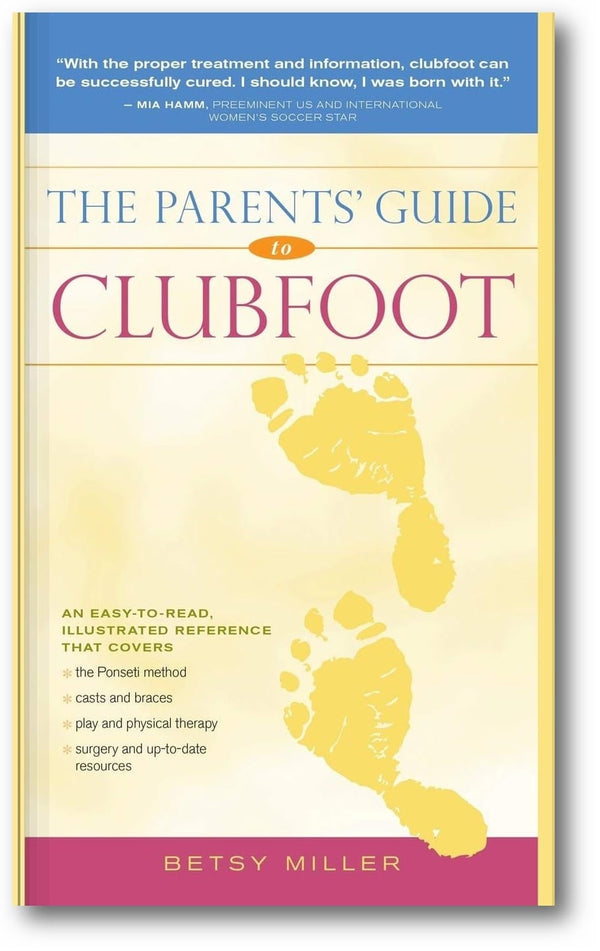
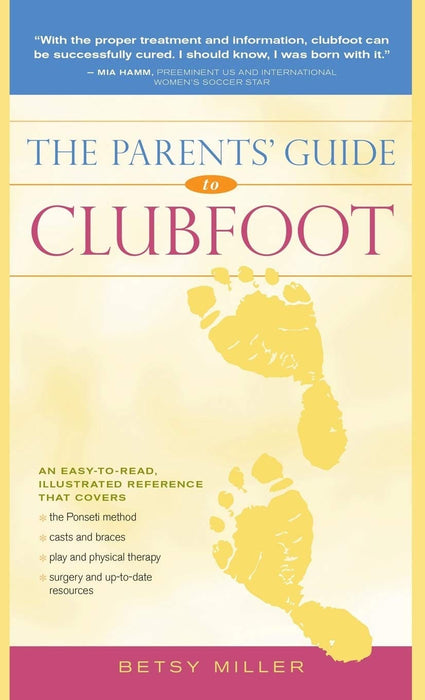
The Parents' Guide to Clubfoot
Written in everyday language, the book covers clubfoot in babies and older children from diagnosis through treatment for mild to severe cases. It provides details on clubfoot, its causes, treatment and care, along with an extensive list of resources and clubfoot assessment aids. In keeping with currently preferred treatments in the U.S., it emphasizes the Ponseti method, which minimizes surgery, and includes perspectives from Ponseti-trained clubfoot doctors and parents of children with clubfoot. However, separate chapters discuss all pre-treatment and post-treatment care options and one chapter covers surgery and post-surgery care if it becomes necessary.
Parents often have a hard time coping with the diagnosis of clubfoot in their newborn children, and this book reassures them that the condition is treatable. If treated correctly, the child’s foot will look normal, and he or she will be fully able to walk, run, and play. Several world-class athletes, including Kristi Yamaguchi, Troy Aikman and Freddy Sanchez, were born with clubfoot. The book includes advice from children with clubfoot that highlights the positive effects of having clubfoot as a child, like getting presents after surgery, and shows active pictures of them after their treatment.
As mentioned, the Ponseti method of treatment - once disregarded as quackery - is the most common method of clubfoot treatment in the United States. It involves a series of casts and braces that slowly reposition the foot. To prevent a relapse, these braces need to be worn until the age of four or five. The book provides instruction, advice and tips for caring for a child in a cast, putting on the different braces required for the Ponseti method, and solving common problems like bruising. It also includes a useful list of signs that a child’s foot is relapsing.
The three most important aspects of the book are:
1. It reassures parents that clubfoot is treatable and that, with the right treatment, their child’s foot will look normal and he or she will be able to walk, run, and play.
2. It is important to find a doctor skilled in treating clubfoot with a nonsurgical approach. This is called the Ponseti method after the late Dr. Ponseti, who developed it.
3. Once a child’s foot is corrected, following through with brace wear as directed until the age of four or five is the best way to prevent a relapse in which the foot needs to be corrected again.
We earn a commission for purchases made through the following links.
Book details
- Author
- Betsy Miller
- Imprint
- Hunter House, an imprint of Turner Publishing Company
- Published
- Pages
- 144
- Formats
- Paperback, Hardcover
- Series
- The Parents' Guide
- Subjects
- Health & Fitness › Diseases & Conditions › Musculoskeletal
Health & Fitness › Children & Adolescents
Medical › Orthopedics - Topics
- Ponseti Method · orthopedic conditions · children's health · physical therapy · braces and casting · parenting a child with disabilities · foot disorders
- ISBN-13
- 9780897936149 (Paperback)9781630268268 (Hardcover)
About the author
BETSY MILLER is a technical writer and co-founder of Thinking Ink Press, a small publisher based in Silicon Valley. Her books include The Parents' Guide to Hip Dysplasia, The Parents' Guide to Clubfoot and The Parents' Guide to Perthes.
Miller serves on the International Hip Dysplasia Institute Advisory Board. Her additional works include the guided journal Beyond Boots 'n' Bars: A Journal for Clubfoot Parents and the edited anthology Clubfoot Connections.
Miller was treated for hip dysplasia as a child, an experience that led directly to her writing on children’s health topics. She also writes short fiction and nonfiction for young readers.
Betsy lives in Cupertino, California.